+603-5131 6160
admin@cciglobe.com
Certification & Accreditation
CARE Certification International (M) Sdn Bhd (CCI) is an ISO 17021–accredited body in Malaysia that provides impartial management system certification and training services.
Core highlights of their quality commitment include:
- Accreditation: Accredited by Standards Malaysia.
- Core Principles: Focuses on strict compliance with ISO/IEC 17021 standards to guarantee impartiality, confidentiality, and objective auditing.

Benefits of ISO Certification:
- Enhanced efficiency, revenue, and employee morale.
- International recognition and consistent processes.
- Factual decision-making and improved supplier relationships.
- Better documentation, process improvements, and customer satisfaction.
Next Steps for Compliance
We Are Ready To Help You
To secure your certificate, you must develop Standard Operating Procedures (SOPs), train your staff, and pass an audit by CARE Certification International (M) Sdn.Bhd and MDA-recognized Conformity Assessment Body (CAB).
Could you tell us what specific role your company plays (e.g., importer, distributor, or service provider) so I can help tailor your preparation steps for certification?
In Malaysia, ISO 37001 (adopted locally as MS ISO 37001) is an Anti-Bribery Management System (ABMS). It is primarily emphasized in Malaysia to combat corporate corruption, satisfy strict legal requirements (Section 17A of the MACC Act), and qualify for government procurement.
The reasons for its prominence and adoption in Malaysia break down into specific operational and legal needs:
- Section 17A Corporate Liability: Under this MACC Act provision, commercial organizations can be criminally liable if employees or associates commit bribery for the company's benefit. The only statutory defense is proving "adequate procedures" were in place. MS ISO 37001 is the gold standard for providing this evidence.
- CIDB Mandate for G7 Contractors: The Construction Industry Development Board (CIDB) mandates MS ISO 37001 certification for all G7 contractors to renew or register their licenses.
- The Construction Industry Development Board (CIDB) mandates ISO 37001 (Anti-Bribery Management System) to combat corruption and ensure structural integrity within Malaysia's construction industry.
- The mandate specifically targets Grade G7 contractors (applying for or renewing SPKK licenses) and is driven by the following key factors:
- Compliance with Section 17A of the MACC Act 2009: This law enforces corporate liability, making companies and top management criminally liable for corrupt acts by their employees or associates. ISO 37001 serves as the primary statutory defense by proving "adequate procedures" are in place.
- National Anti-Corruption Strategy (NACS): The construction sector and public procurement are highlighted as high-priority areas. The mandate directly supports national objectives for transparency and accountability.
- Government Tender Requirements: The Ministry of Finance requires ISO 37001 for companies bidding on large-scale public infrastructure projects.
- The mandate, outlined in CIDB Pekeliling Bil. 1/2026, requires all G7 contractors to hold a valid ISO 37001 certificate for new SPKK applications and renewals. Non-compliant contractors’ risk being disqualified from tendering for government projects.
- Government Procurement & ESG: Many government agencies and public sector initiatives require vendors to hold ABMS certification to ensure transparency in public funds. It also elevates an organization's Environmental, Social, and Governance (ESG) standing by ensuring ethical board-level governance.
- Global Credibility: The standard (overseen by the Department of Standards Malaysia and MACC) provides a globally recognized framework to prevent, detect, and respond to bribery incidences
Certification Process
- Application: Submit required information, followed by agreeing to quotes and terms.
- Stage 1 Audit: On-site document review and identification of improvement areas.
- Pre-assessment (Optional): Prepares organizations by identifying potential issues.
- Stage 2 Audit: Comprehensive on-site assessment, including internal audits and correction of weaknesses.
- Certificate Registration: Issued after successful review and resolution of outstanding issues.

Surveillance Audits: Conducted every 6-12 months to ensure compliance and suggest improvements.
Transfer of Certification: Switching to CARE Certification International is hassle-free, with no additional charges, and assessments align with prior schedules.
ISO Standards Audit Cycle

The ISO Standard has an audit cycle of 3 years.
The first year being Initial assessment to assess the company's existing process, Procedure and control and compliance.
The second and the Third year will be Surveillance Audit, which is to maintain the compliances of the client.
Follow up by the Third year will be Recertification which assess the changes and improvements of the client. It is also the starting of a new cycle.
Use of Care certification Logo
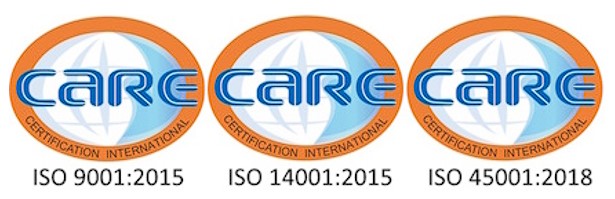
Certified logo will be provided by Care Certification when requested and clients are only allowed to use the certifiied logo with the corresponding standard that they are certified with.
The Certified logo could be use on public relations material such as Clients letter, Business card, website and on emails.
Clients are not allowed to make modifications to the provided certified logo. The client May request modifications to the certified logo. but the final decision rest with Care Certification.
Should a certificate be suspended or withdrawn, the client must cease using the certified logo on any advertising materials or public relations purposes.
In case of incorrect usage of the certified logo, Care Certification May request for corrective actions.